
Anastasia the Musical: From Screenplay to Stage Door (Pt. 2)
- Lauren Elise Funaro
- Dec 7, 2017
- 9 min read
Updated: Feb 20, 2020
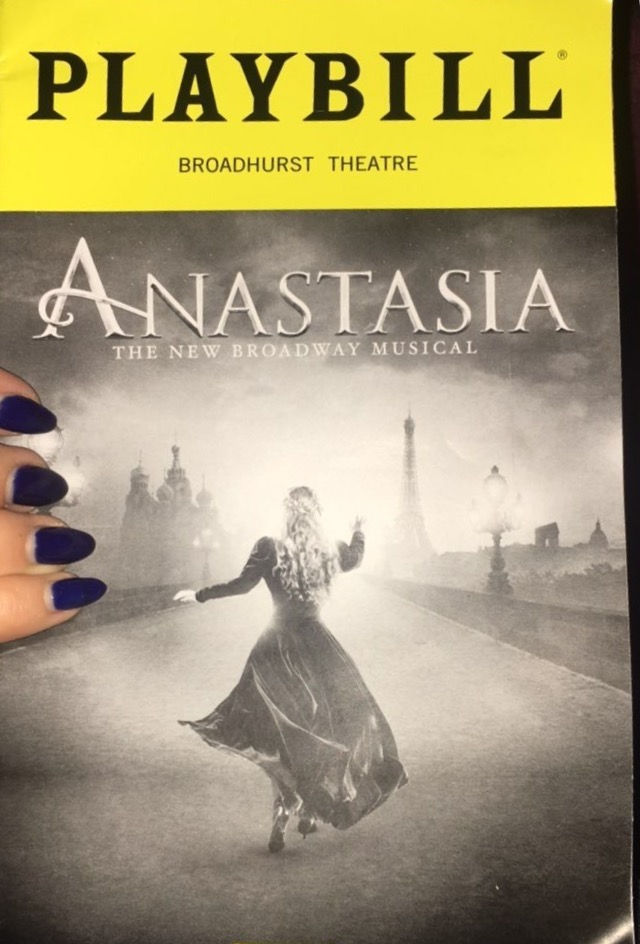
[Absolutely a Spoiler Review] In case you've missed the 90s nostalgia currently flooding our cultural climate, the movie Anastasia of everyone's childhood goes as follows: A narrative voice sounding suspiciously like Mrs. Potts from Beauty and the Beast, (because, surprise, it IS Mrs. Potts from Beauty and the Beast) goes through a five minute run down of the dissolution of the Russian Empire, caused, of course, by the BIG BAD Rasputin, who sent a flurry of flying minions to start the Russian Revolution and murder the Czar and his family for no real reason. Mrs. Potts aka the Empress of Russia pulls along her favorite granddaughter in search of safety. They catch a train, but the granddaughter (three guesses at her name) loses grip and falls. The scene changes. Ten years later a chorus of bedraggled Russians sing about the downfall of their faultless monarch before telling us what we might have guessed: Anastasia could still be alive! Cue the dance number and enter our hero, Dmitry, who is also a con man. He's needs someone to impersonate Anastasia because he wants...prize money? A ticket out of Russia?
This is as unclear as it is unnecessary, but it does give him some sort of motivation. Moments later we re-meet Anastasia, who we all know is the girl from years before, though she doesn't have a clue (Dramatic Irony: For Kids!) Now Anastasia goes by Anya, and soon she and an adorable puppy happen upon Dmitry and his co-conspirator, Vlad. Anastasia has a necklace with the word "Paris" on it, and that happens to be exactly where the Dowager Empress lives! And so our team sets off. Throw in some zippy one liners from Rasputin's bat sidekick, and some terrifying imagery that could only be produced by late 90s CGI, and you've bought yourself a rousing good time. One that had this blogger pressing "rewind" enough to break the VCR.
Our new Anastasia is a different breed. Aged and refined though juggling a cacophony of mixed demand. Lynn Ahrens and Stephen Flaherty, veterans of the animated film, set out to create a story outside of its source material. Their aim was to articulate the legend as if it had actually happened. If there really was a duchess who'd forgotten who she was and found her truth during the tumultuous period of Bolshevik rule, what would it look like, sound like, what would she feel? The musical plays like a love letter to the myth of her survival, an homage to a memory that might have been.
Of course, writers could not outrun the beloved classic. The lighthearted romp through postwar Russia and Paris faced a revamp that layered it with ambiguity. This union was bound to face some growing pains, and it certainly does-- the stage production is not faultless. But what it manages to pull off is still impactful, heartfelt, and beautifully rendered.
They did this in a number of ways. Starting with:
1) Fleshed out History
"Rasputin is Bad, Royalty is Good, and Communists are the worst." Check, check, and check. The cartoon has a clear stance on who-is-what in its rendering of history. That's because, really, the history wasn't all that important. Anastasia's backstory was merely a vehicle to get our characters from point A to point "adventures and hijinks." With 95 minutes to relay a plot audiences would flock to, this was not the time to discuss the macabre of shades lining Russia's monarchal downfall. The revolution (caused, remember, by the zombified Rasputin and his flying bat fiends) became sole catalyst for the country's negative social climate. This is claimed by the song "Rumor in St. Petersburg."
"Oh, Since the Revolution, our lives have been so gray
Thank goodness for the gossip that gets us through the day!"
There is no reference to societal unrest in the decades preceding the fall of the empire, of the overpopulated cities, or the thousands starving while royalty retained its wealth. Of course not, it's a kid's movie! It plays on one note and does it well. But the musical is a two act set, and it took seriously the duty of layering on stage the framework its predecessor so lacked. Now, "Rumor in St. Petersburg," begins with the revolution's promise:
"Together we will forget a New Russia, that will be the envy of all the world!"
When the song begins, our conman Dmitry is at the forefront, and he mocks this statement, saying that while the Bolsheviks tell them "times are better," he begs to disagree. This is an important distinction from the film's introduction. Instead of being the CAUSE of Russia's downfall, the revolution has not fixed a problem ALREADY there during royal rule. From those first moments we learn the "villain" of this story will not be painted with just one stroke.
Because of this and similar changes, Anastasia developed newfound texture, one where the massacre of an entire familial lineage remains devastating and poignant. Still, it does not demonize those on the opposing end (although that could certainly use some more emphasis.) By placing her story back within the context of a torn country, we gain insight and thematic agency that refine its original script.
2) Caricature's become Characters
The main players in the cartoon are clever and whimsical. They are also not anything you'd win awards for. The most dynamic person in the film is probably the Dowager Empress, but that's mainly because the woman behind Mrs. Potts can do little wrong. Still, she plays the part more obstinate than heartbroken by great loss. Dmitry's motives and change of heart are unprecedented, and secondary character's like Vlad and Sophie have little purpose aside from exposition or comic relief. Even Anastasia, upon finally remembering who she is, has no moments of debilitation. She falls into her role with ease, kills the bad guy, then leaves her kingdom for Dmitry relatively unruffled. All in time for Rasputin's cute bat sidekick to switch sides and get a girlfriend.
So, the musical had some roles to tweak. These people needed grounding. Now, when we first see Anastasia as an adult, she is momentarily stricken by a backfiring truck. This panic implies trauma she cannot place. It stems, of course, from the fire squad that destroyed her family, though she can not remember. Small references like this draft nuances in character. She is hopeful, but deeply disillusioned, much unlike her film counterpart. She wants to go to Paris because of some hint of a memory she cannot place-- but this Anastasia knows what the stakes are.
Similarly Dmitry, placed in the chaos of a "New Russia," now has an articulated motive. Borders are closing. Paranoia is high. If he and Vlad want to leave the country, they need to think of something fast. He is a conman because he grew up an urchin on the streets of St. Petersburg, and he and Anya connect through their loneliness and scrap. Vlad too is fully fleshed. He is still funny as all hell, if totally manipulative (but in a lovable way?) He schmoozed with the royals until the revolution, then found he had no where to go.

Now for the opposing team. Gone is our decaying, petulant Rasputin and his adorable Bat Friend, Bartok. In their place, we have the Communist regime. The further implications of legacy and duty are thematic weights in this adapted plot. Gleb, a Bolshevik whose father had a hand in the Romanov assassinations, is an honorable man. He loves his country and believes he is serving it well. The theme of his and Anya's linked legacy is woven through the musical's "cat and mouse" hunt. He is well crafted, perhaps because he had no place in the animated film. Gleb is not limited by predetermined character notions. He is at his strongest in the climactic ending, though I do wish certain points (how he learns about Anya's plan to reach the Dowager Empress, and his attraction to Anya in the first place,) felt less tacked on.

(Rasputin's character never had this type of tension)
A surprise I didn't anticipate was the introduction of compelling Lily Malevsky-Malevitch (say that ten times fast.) Called "Sophie," in the cartoon, Lily is The Dowager Empress's last Lady in Waiting. Where in '97 she was a bumbling frenchwoman who giggled into our hearts, here she is a dry and hearty Russian. Her past affair with Vlad remains the trio's segue to the Empress, though now that relationship has a vivid backdrop (so vivid you'd tell them to get a room if they weren't on stage.) Plus, she's hilarious and manages to drink half of Russia's elite under the table.

Still, as much as I love these additional characters and their affects on the plot, I do think some of our leads suffer from this shift. Dmitry, in this new context, loses a bit of his edge (the one that had me doodling his name in hearts during preadolescence). In this new construction he simply has less to do. Further, he and Anastasia share less of the quips and quick-witted retorts that made them so fun. Anastasia is more staid and part of me misses her spitfire. They do remain earnest, and I was certainly ready to pledge my love for both of them by curtain call. However, it seems that in this balancing act, such elements fell short.
3) The Music We Remember (Made Over)
Before fans signed petitions or made posts, the songwriters behind the '97 Anastasia had hopes for more to come of their project. By the time it reached the stage, they'd expanded the score to include nineteen more songs. Of course, they needed to find flow between songs sung by nineties tweens in the shower and Broadway caliber hits. Because of this, the play has bouts of tonal indecisiveness. The grit of the newly sculpted plot has less room for the froufrou of "Paris holds the Key to Your Heart," (don't you worry, they managed to put that one in) but they could hardly toss out fan favorites.
More often they manage to confront the issue with redrafted lyrics, like in the aforementioned example of "Rumor in St. Petersburg." These lines are written again with specified intent. They also adjust the timeline, placing songs in areas that make more contextual sense. Upon meeting Dmitry and Vlad, Anastasia sings her first song, "In My Dreams," about the terrors of waking up without memory. This is worlds away from the cartoon's stroll down snowy streets to "Journey to the Past." "Journey" is moved with her progressed arc to end act one. This was a very smart move. Considering the song's popularity, it warranted more emphasis. "Learn to do it," the closest to an act one ender in the film, is moved up to engage audiences with the plot earlier.
Much of the music used as background in the movie now fleshes out into titled songs. This is a fun take on memory, as often I would hear the beginning notes of a new number and realize I'd heard the tune before. This helped stabilize the shift, centering the show's audience when the tone veered far left. With fan favorites such as "In the Dark of the Night" cut from the score, sprinkles of the melody serve as a rightful salve.
With the lyrics being so cleverly rewritten, I did find one issue that for me is a total plot hole. It's so small that it's perhaps unnecessary to add, but as I will continue to complain about it regardless, it may as well appear in writing. In the beginning of the movie, The Dowager Empress and a young Anastasia sing a lullaby together. It goes as follows:
"On the Wind, cross the Sea, hear this song and remember
Soon you'll be home with me, once upon a December."
Later, an adult Anastasia enters a ballroom to realize she has been there before. This triggers a memory and she sings a song with the same composition. The final verse in that song goes like this:
"Far away, long ago, glowing dim as an ember
Things My heart used to know, things it yearns to remember."
She pauses. Then continues with:
"And a song someone sings: Once Upon a December."
It is a poignant moment, as Anastasia's past still alludes her. It is a very articulate and lyrically nuanced way to express confusion at this ghost of a memory. However, in the play, when the Empress and Anastasia first sing the song, the lyrics are changed to match that last line. Now when they first sing the lullaby the line reads "Far away long ago... And a song someone sings, once upon a December." But that doesn't make sense, because now when Anastasia sings the line again, she is just repeating lyrics that don't fit with the context of the little girl and grandmother. It loses its emotional impact, and honestly is so unnecessary. Someone (who for some reason cares as much as I) might argue that because they're singing a lullaby it doesn't matter what the line is. But that makes it worse, because if it doesn't matter there was even less reason to change it.
But I'll step down from my soap box, if only because I've stood on it for far too many pages and my hand is starting to cramp. There is so much more to unpack in this show, as overall it was an astounding performance-- filled with spectacle and lucrative storytelling. I'm willing to embrace every bump and bruise for that final product.
There is so much more to say. Are you ready to take the journey? Sounds like you'll need to stay tuned for part 3!


Comments